 Nether
 combines Ethereum execution software with blockchain engineering and security research
Nether develops the Nethermind Ethereum execution client and provides protocol engineering, security services and infrastructure operations. The client is written in C# on .NET and executes Ethereum Virtual Machine transactions. A separate consensus client handles the proof-of-stake chain. The wider organization builds rollup infrastructure, develops cryptographic systems and maintains tools for Ethereum and Starknet. Running the client, extending a network and commissioning managed infrastructure involve different technical responsibilities.
The short version: Nethermind's plugin framework allows client customization without maintaining a separate fork, with compatibility requirements tied to the release being deployed.
The execution client and consensus client share node duties
Nethermind executes transactions through the Ethereum Virtual Machine and maintains chain state, while a consensus client follows Ethereum's proof-of-stake chain. The consensus client determines which block comes next. Running them together provides an Ethereum node, which can answer queries about the state that transaction execution produces.
The network portfolio includes Ethereum mainnet and public testnets, Gnosis Chain, XDC and OP Stack chains. Bespoke networks can require client features outside the standard Ethereum execution model. Shared EVM compatibility therefore leaves room for chain-specific engineering and maintenance requirements. Execution-client inconsistencies can also cause nodes to diverge from consensus and create forks.
RPC access and plugins support different workloads
JSON-RPC lets applications request blockchain data and use execution functionality through a defined interface. Nethermind provides tracing and transaction-pool functionality alongside chain queries, with module availability governed by configuration. Its plugin framework supports extensions for RPC, tracers, state visitors, networking, transaction-pool behavior and command-line features. These extension points let developers add client functionality without maintaining a separate fork of the client. Enterprise users can also obtain client support and maintenance.
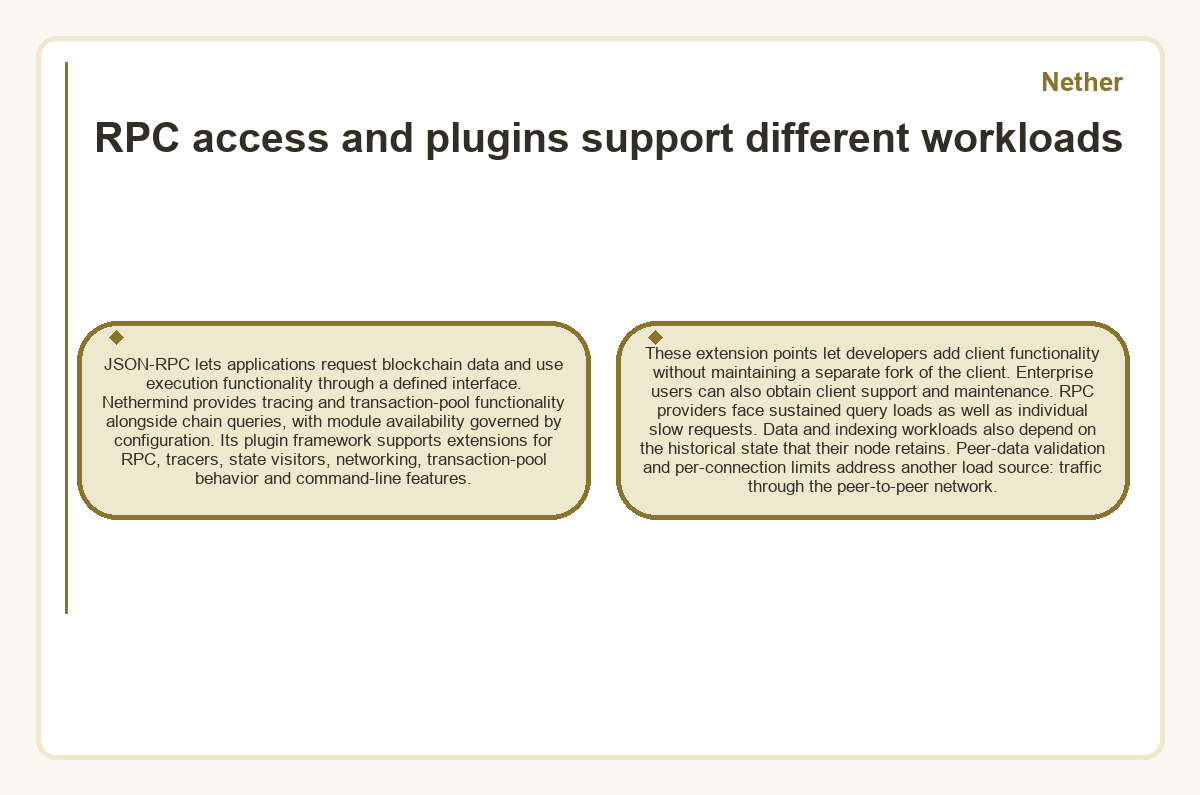
RPC providers face sustained query loads as well as individual slow requests. Data and indexing workloads also depend on the historical state that their node retains. Peer-data validation and per-connection limits address another load source: traffic through the peer-to-peer network.
How much Ethereum history can the client retain?
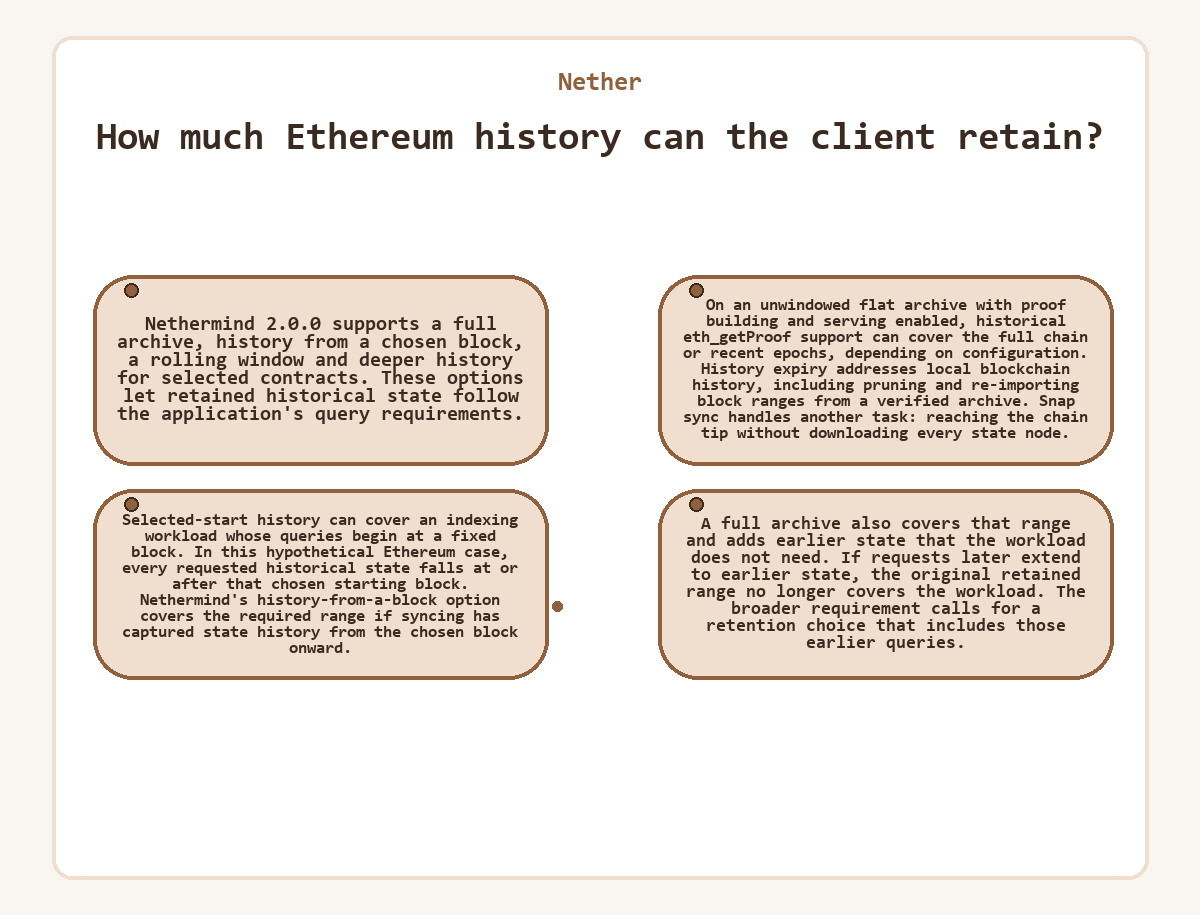
Nethermind 2.0.0 supports a full archive, history from a chosen block, a rolling window and deeper history for selected contracts. These options let retained historical state follow the application's query requirements. On an unwindowed flat archive with proof building and serving enabled, historical
eth_getProof
support can cover the full chain or recent epochs, depending on configuration.
History expiry addresses local blockchain history, including pruning and re-importing block ranges from a verified archive. Snap sync handles another task: reaching the chain tip without downloading every state node.
Selected-start history can cover an indexing workload whose queries begin at a fixed block. In this hypothetical Ethereum case, every requested historical state falls at or after that chosen starting block. Nethermind's history-from-a-block option covers the required range if syncing has captured state history from the chosen block onward. A full archive also covers that range and adds earlier state that the workload does not need.
If requests later extend to earlier state, the original retained range no longer covers the workload. The broader requirement calls for a retention choice that includes those earlier queries.
Security work spans audits, formal verification and developer tools
Nethermind Security works on smart contracts, protocols and infrastructure through audits, formal verification and AI-assisted tooling. Code review examines implementations for flaws, while formal verification checks specified behavior through mathematical reasoning. The properties under examination define the scope of a proof; a narrow specification cannot establish every property of a wider system.
Clear is a formal verification framework for Solidity programs. AuditAgent uses AI to help developers examine smart contract security. ZK audits form another part of the security offering. A contract review, a protocol assessment and infrastructure security work concern different objects, so the engagement's scope matters when interpreting its findings.
Protocol research extends into rollups and ZK execution
Core Engineering works across Ethereum execution, rollup infrastructure and zero-knowledge execution environments. Rollup work includes execution clients, sequencing systems, prover integrations and developer tooling. The portfolio covers optimistic, ZK and based rollup architectures, with engineering responsibilities that vary across their execution and proving components. Interoperability work includes cross-chain messaging, bridge engineering and ZK circuits for cross-chain systems.
Protocol contributions include cross-client coordination during upgrades, account abstraction and blob transactions. Blob transactions provide additional data space that serves rollup scaling. The wider portfolio also includes Ethereum Object Format implementation work, Verkle-tree development and work on a .NET implementation of Libp2p. Applied cryptography, formal methods and post-quantum cryptography extend the research scope.
ZK execution work includes Ethereum execution binaries compiled for RISC-V64, execution witness generation and stateless block replay. These components support integration with zkVM environments. They address making Ethereum execution provable as those environments mature.
Nethermind's Gas Benchmarking Framework supports research into Ethereum gas-limit expansion. Related performance work examines worst-case execution, adversarial workloads and parallel execution. FlatDB addresses storage-related execution costs by reducing trie traversal. This work targets bottlenecks that appear as execution demands and retained history grow.
Ethereum and Starknet tools cover nodes, exploration and development
Juno is Nethermind's Starknet client, while Voyager provides block exploration and analytics for Starknet.
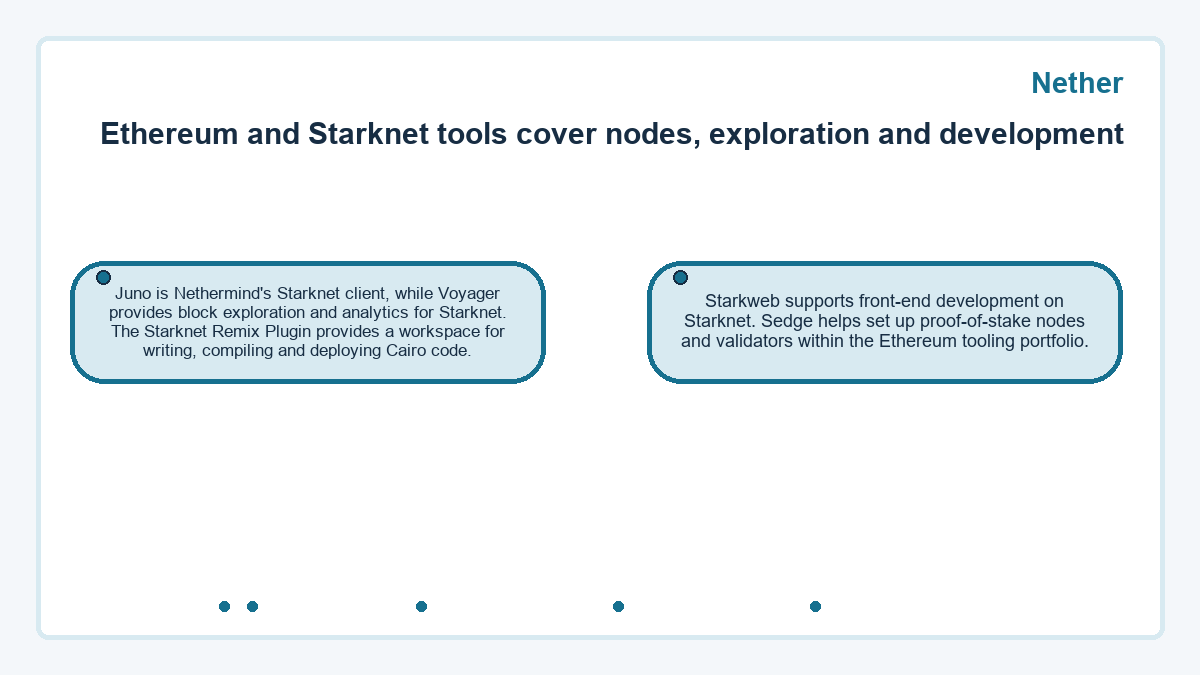
The Starknet Remix Plugin provides a workspace for writing, compiling and deploying Cairo code. Starkweb supports front-end development on Starknet. Sedge helps set up proof-of-stake nodes and validators within the Ethereum tooling portfolio.
Institutional infrastructure adds operations and policy controls
Managed infrastructure covers node deployment, monitoring, validator operations and resilience across cloud and hybrid environments. Wider engineering services include tokenization platforms, staking vaults, treasury systems and portfolio management. Identity and compliance work includes verifiable credentials, on-chain KYC and AML systems, sanctions screening and transaction monitoring.
Bedrock is Nethermind's institutional software, built on its execution client. It is in early access. Nethermind's September 21, 2026 report describes two completed proofs of concept with UBS testing policy controls at the infrastructure layer. Both ran on Sepolia Testnet without live transactions or changes to Ethereum's protocol. Described controls include restricting transactions to pre-approved addresses and blocking specified contract interactions.
The DeFi Gateway portfolio manager for a regulated securities firm combines KYC verification, risk profiling and automated trading and asset allocation. That system requires explicit human confirmation at every execution step.
Who needs specific guidance before upgrading to Nethermind 2.0.0?
Nethermind 2.0.0 introduces breaking changes that require archive operators, custom-configuration users and plugin authors to read the release's upgrade guidance. An earlier working installation does not establish compatibility with the new release. Release engineering also uses Ethereum fixtures, conformance testing and end-to-end scenarios across multiple platforms and configurations.
Deployment planning also needs to distinguish standard client operation from bespoke protocol engineering. A plugin can extend the client through supported extension points, while a network-specific implementation can carry its own maintenance responsibilities. The choice between a standard deployment, an extension and custom client work follows the network behavior and data access that the system requires.
Quick answers about Nether
Is the Nethermind client free to run?
The Nethermind client is open source and free to run under LGPL-3.0. Managed node operation is a separate offering, and a self-hosted deployment still needs computing resources.
Where can the Nethermind client run?
Nethermind supports Linux, Windows and macOS on x86-64 and ARM64. Suitable storage and processing capacity still depend on the retained history and the execution or RPC workload, so platform support alone does not determine a deployment's resource requirements.
Can a Nethermind node help other nodes synchronize?
A Nethermind node can serve snap data so other nodes can synchronize from it. Snap serving supplies data, while snap sync receives it. This capability allows nodes to bootstrap from each other, reducing their dependence on public peers when the nodes provide the required data.
How can operators monitor a Nethermind node?
Nethermind supports Grafana dashboards, Seq logging and durable sync-time metrics for inspecting node activity. Dashboards present monitoring data, logs record node events and synchronization metrics describe the client's progress during syncing.
What does Paprika contribute to the Nethermind client?
Paprika is a custom database implementation for Ethereum state and storage trees in the Nethermind client. The project targets reorganization-aware, checksum-based storage systems.
Updated on